Longitudinal Art Research
What does a museum visit do to people over time? Not whether they enjoyed it, but how many stars they'd give it — but whether the images lingered, whether it fed their curiosity, whether it challenged their perspective in the weeks after they walked out.
That question has never been empirically answered. Echo Room is the multi-purpose instrument to research this.

Echo Room is built as both a research instrument and a social space for museum visitors, as its goal is also twofold: to research the longitudinal effect of museum visits and to create a social space where museum visitors can share their love for art without algorithmic intervention.
The Instrument
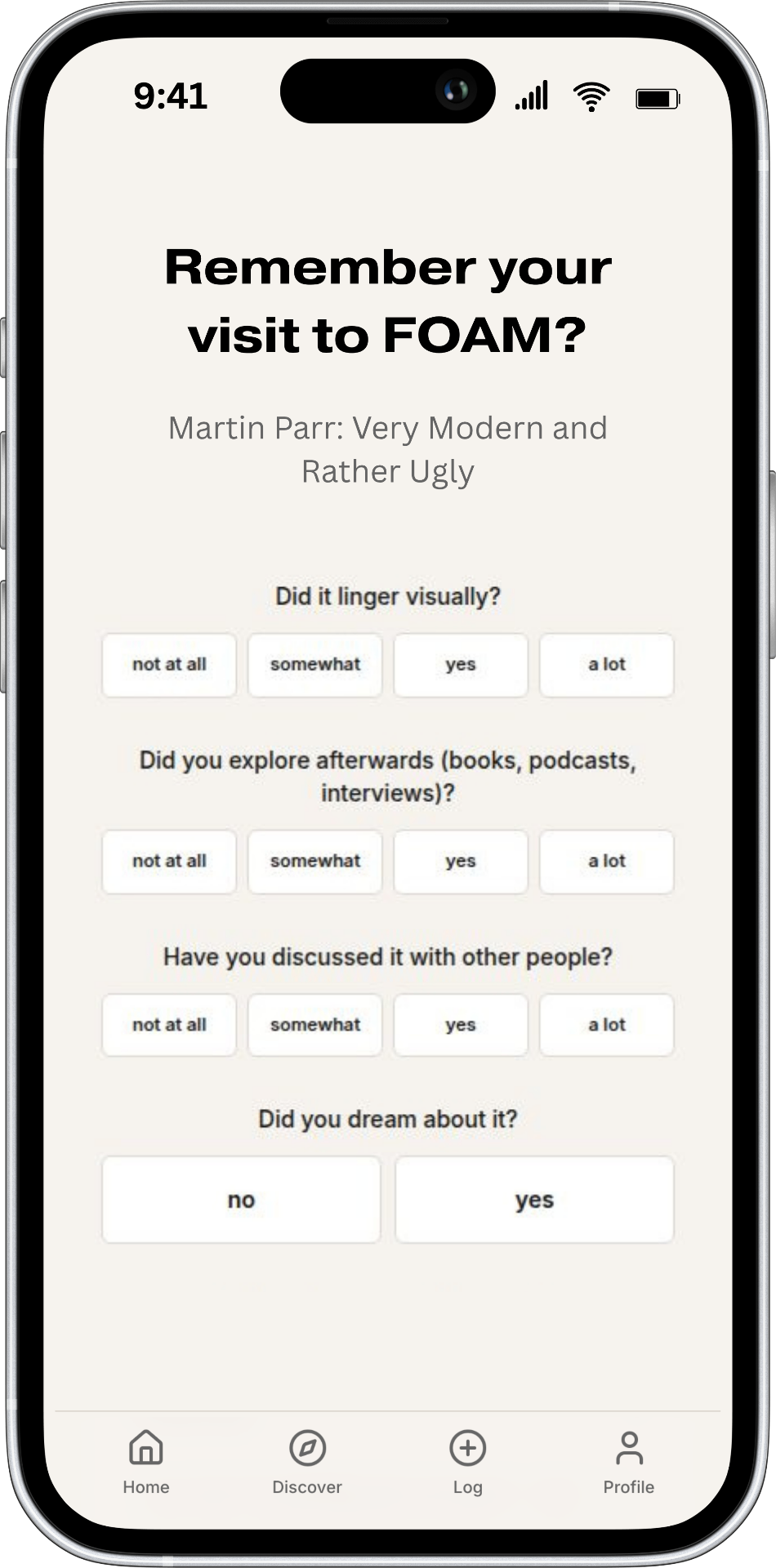
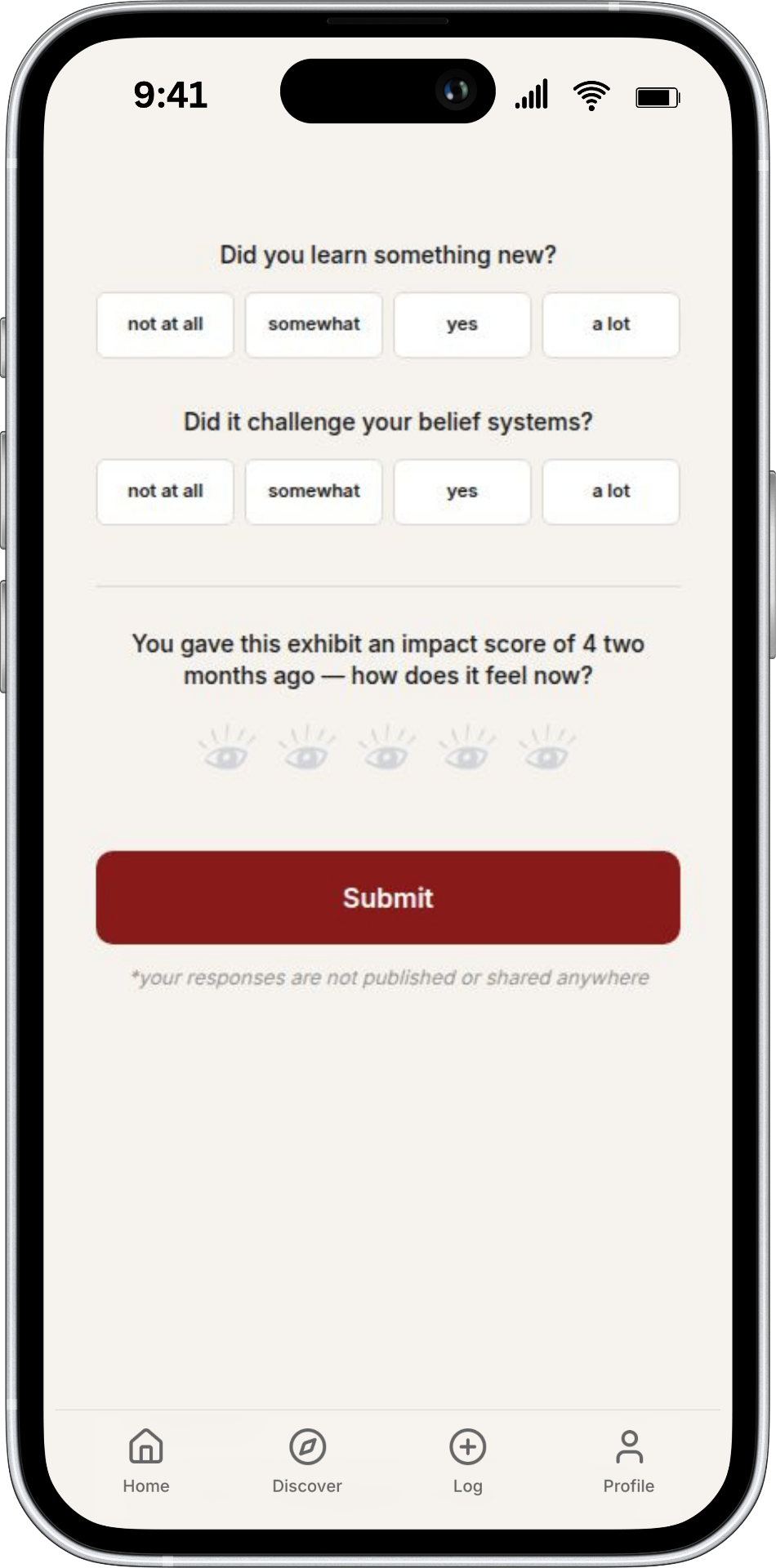
Echo Room captures two data points from every museum visit: the immediate effect and the long-term effect. The delta between the immediate response and the echo is where the research lives.
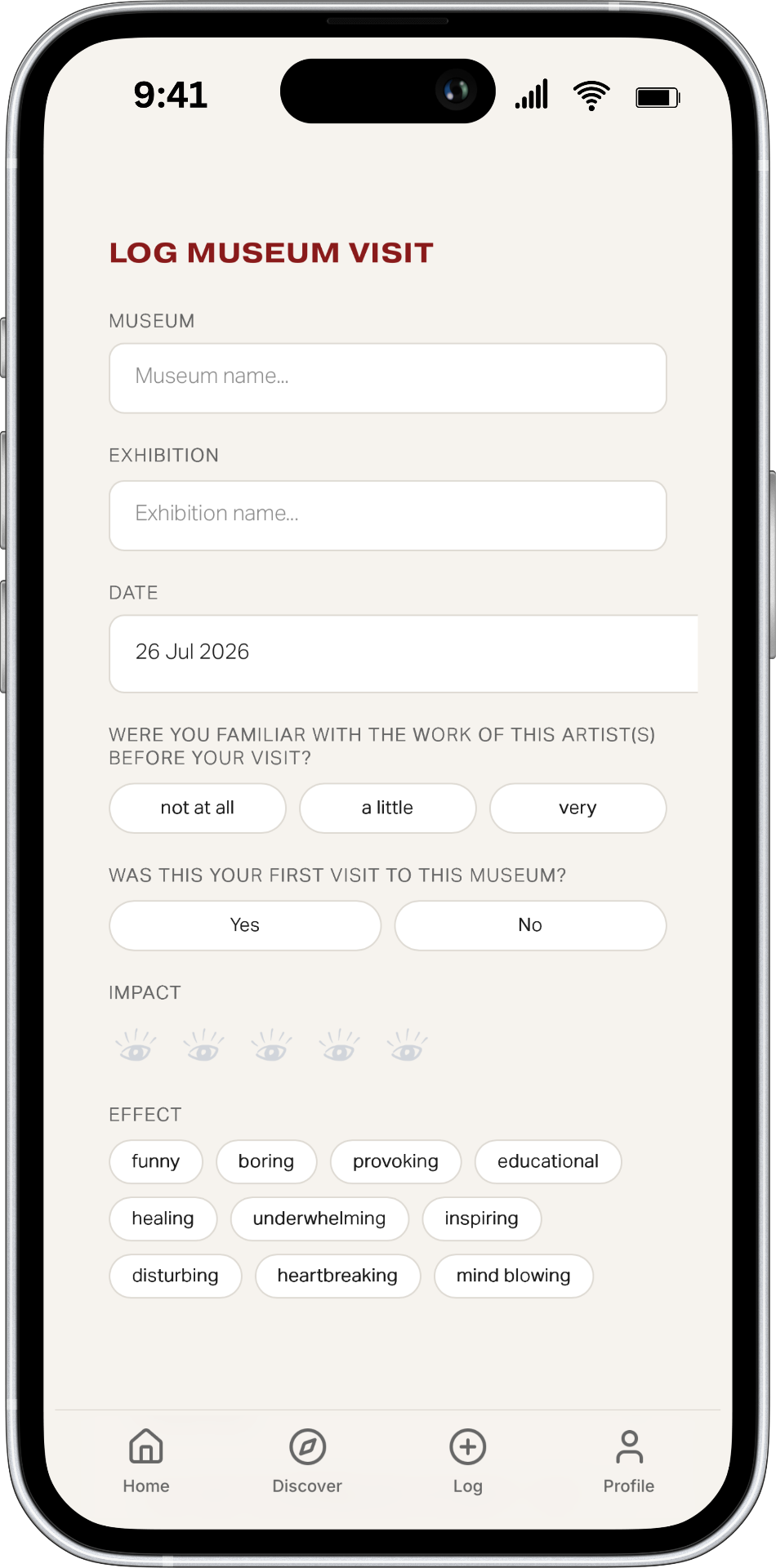
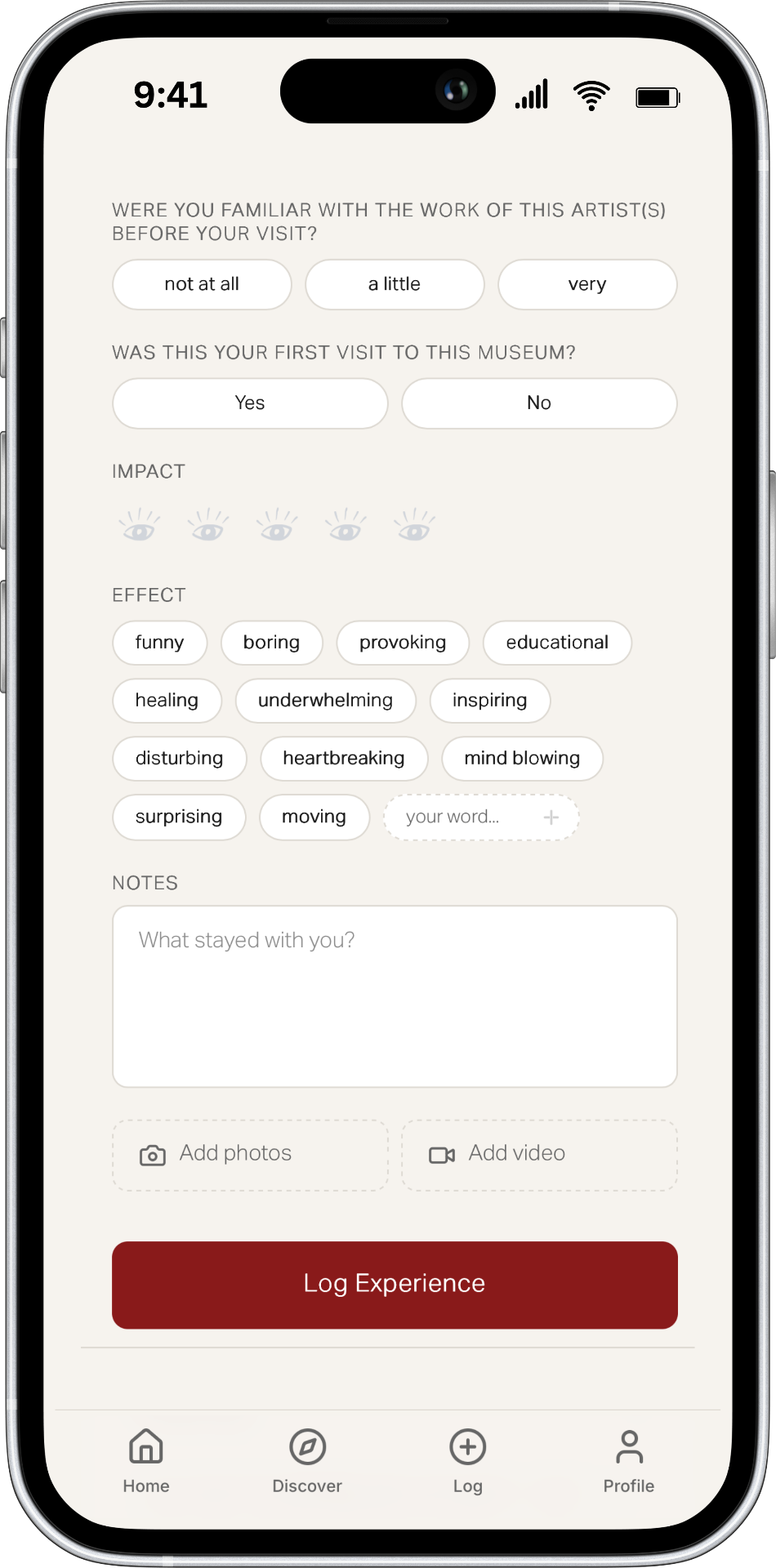
1. The Log
Immediately after an exhibition, participants log their felt experience: selecting effect tags, rating the visit, and noting what the encounter did to them. It's explicitly designed to reflect, not review, a visit.
2. The Echo Check
Eight weeks later, the instrument returns — and asks what stayed across three dimensions: permanence (did it linger visually, emotionally, rationally?), behaviour (did it send you somewhere else — a book, a podcast, a conversation?), and transformation (did it challenge something, shift a perspective, change anything?).
What We're Measuring
Echo Room generates a dataset that has never existed before: a longitudinal record of what museum visits do to people over time. At the individual level, participants discover what kind of experiences stay with them and what activates their cultural life beyond the museum walls.
At the exhibition level, museums can see which shows do the most cultural work — independent of visitor numbers.
At the sector level, the aggregated data produces findings on belonging, discovery, participation cascade, and the relationship between the quality of an aesthetic experience and its long-term cultural impact.
The instrument is free, ad-free, and built around one conviction: that how art makes you feel matters more than what you know about it.
Echo Room draws on the combined forces of empirical aesthetics and neuroaesthetics to uncover the eudaimonic effect of museum visits.
Instrument Validation
Echo Room's instrument is designed at the intersection of two established fields. Empirical aesthetics provides the theoretical framework for measuring aesthetic experience in naturalistic settings — outside the laboratory, with real visitors encountering real exhibitions in real time. Neuroaesthetics provides the scientific grounding for the claim that art produces measurable cognitive and affective impacts that extend beyond immediate pleasure or displeasure.
The echo check questions draw directly on existing taxonomies of aesthetic impact research establishing that what art does to people is multidimensional, encompassing visual memory, emotional resonance, rational engagement, behavioural activation, and transformative effect. The effect tag taxonomy — the immediate response categories participants choose at the point of logging — is grounded in the same body of evidence that makes language people use to describe aesthetic encounters itself structured, meaningful, and measurable.
Before the dataset is analysed, the instrument undergoes formal psychometric validation: assessing whether the echo check dimensions measure what they claim to measure, whether the scale items are internally consistent, and whether the temporal design — eight weeks as the interval between log and echo check — is theoretically and empirically justified. That validation process draws on the methodological standards developed within empirical aesthetics for ecologically valid museum research.
Echo Room works with a global team of researchers to build this project from the ground up. We are always looking for new perspectives and ideas.
Open Call to Collaboration
Echo Room is an open research infrastructure — designed to grow through collaboration rather than in isolation. There are several ways to contribute, depending on who you are and what you know.
Academic researchers and universities: if your work touches empirical aesthetics, neuroaesthetics, cultural participation, memory, or the psychology of art, Echo Room may be a natural fit for your research agenda. We are actively building a network of academic collaborators for instrument validation, co-authorship on findings papers, and joint grant applications. We are particularly interested in researchers working at the intersection of felt experience and measurable behaviour.
Tech contributors: the instrument is built and functional, but there is meaningful work to be done on data infrastructure, visualisation, and the backend architecture that will support the research at scale. If you work in data engineering, UX, or research software development and want to contribute to an open cultural research project, we'd welcome a conversation.
If none of these categories quite describe you but you think there's a conversation worth having, reach out. The most interesting collaborations rarely arrive pre-labelled.